Working Papers

The Micro Effects of Aggregate Shocks in Endogenous Trade Networks
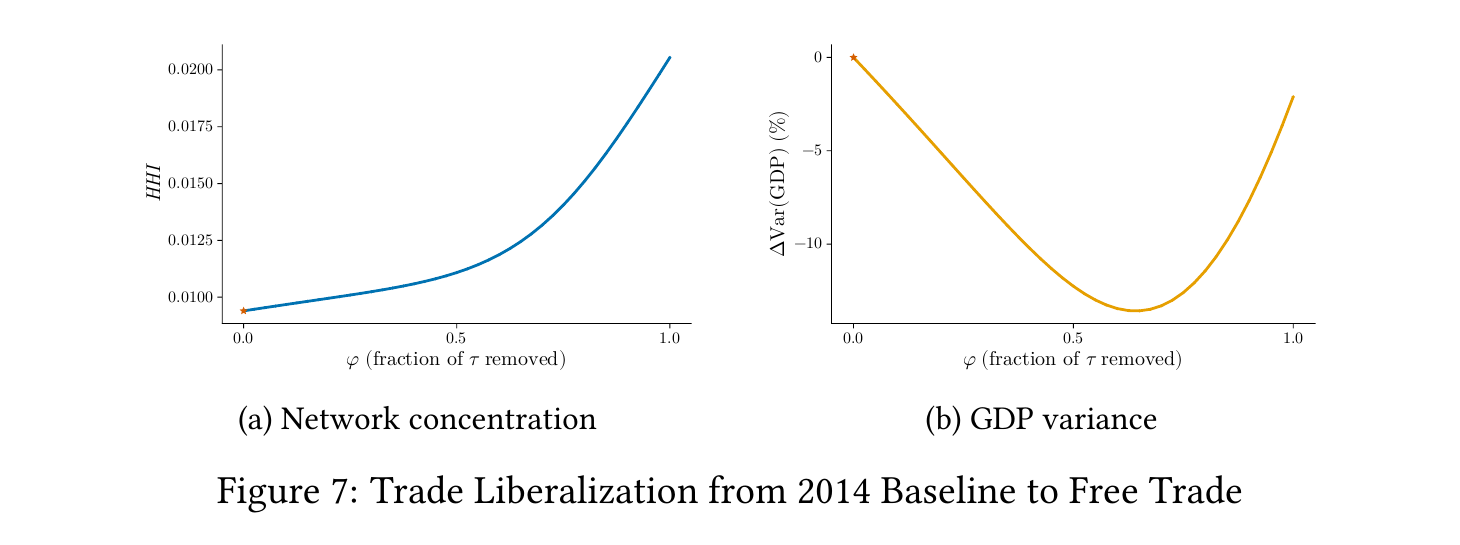
This paper studies how trade liberalization affects aggregate risk. I develop a multi-country model where firms choose suppliers trading off cost against risk. Calibrating to Long-WIOD data, I find that openness and risk are non-monotone: moderate liberalization reduces GDP variance through diversification, but when trade barriers are sufficiently low, production concentrates sourcing in productive central suppliers, raising efficiency but amplifying shock propagation and aggregate risk. In addition, under incomplete markets, firms price the risk against domestic rather than world conditions, generating inefficiencies in the production network.

Take the Short Route in Confidence Crises

Co-authors: Teerat Wongrattanapiboon

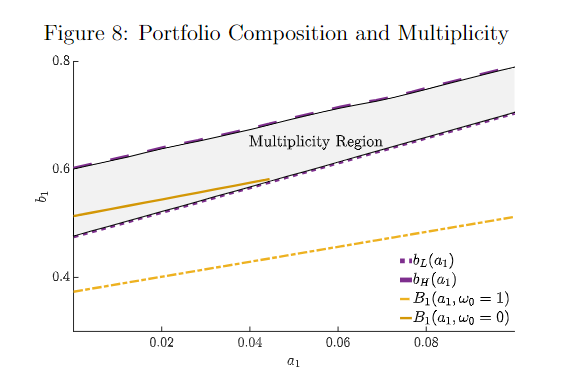
During the 2010-2012 European debt crisis, Italian sovereign spreads spiked far beyond what fundamentals could explain, while debt maturity shortened. Existing quantitative work attributes only a modest role to self-fulfilling risk. We develop a sovereign debt model with endogenous maturity and Calvo-style self-fulfilling crises in which long-term bonds carry within-period confidence risk and short-term debt insures against it. Maturity shortening is the optimal response to the increase in confidence risk, not evidence against it. A particle filter on Italian data attributes roughly 80 percent of the late-2011 spread spike to a rise in confidence risk, with direct implications for crisis interventions.

Debt Sustainability, Confidence Risk and International Reserves (R&R in RED)

Co-authors: Teerat Wongrattanapiboon

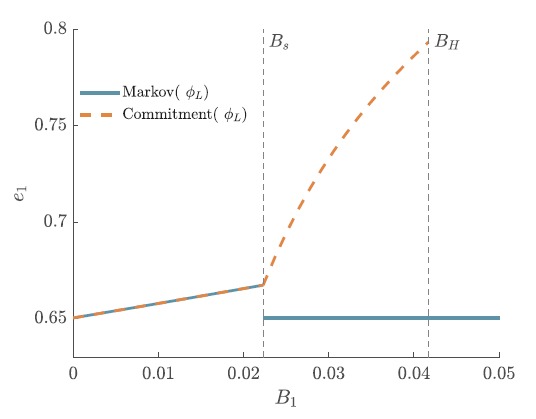
This paper analyzes how a government can use reserves to prevent a self-fulfilling crisis, as described in Lorenzoni and Werning (2019), where confidence-driven fluctuations affect bond prices. We propose a three-period model in which the government follows a fixed fiscal surplus rule and chooses the optimal reserve accumulation policy. Our analysis reveals a new mechanism for which debt-financed reserves provide insurance against self-fulfilling crises in the presence of long-term bonds. We also present empirical evidence that governments tend to accumulate reserves during periods of exceptionally high spreads and show how our theoretical framework could help explain this empirical pattern.

The Political Economy of Credit Booms and Macroprudential Regulation

Co-Authors: Javier Bianchi - Cesar Sosa-Padilla

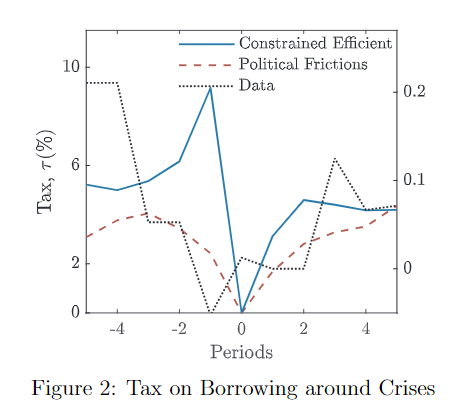
We study how political economy frictions reshape macroprudential policy and the dynamics of credit booms in an open-economy model of financial crises. When policymakers with heterogeneous regulatory biases alternate in power, a forward-looking, responsible regulator tightens preemptively — setting tighter capital controls even when near-term risks are low. Quantitatively, political frictions generate regulatory cycles in which extended tranquility is followed by deregulation and crises, consistent with event-study evidence around sudden stops. Finally, the framework clarifies why conventional empirical estimates can understate the effects of regulation on capital flows, and shows how political shocks can be used to remedy this endogeneity.

Sovereign Debt, Currency Composition, and Financial Repression

Co-authors: Teresa Balestrini - Leonardo Barreto

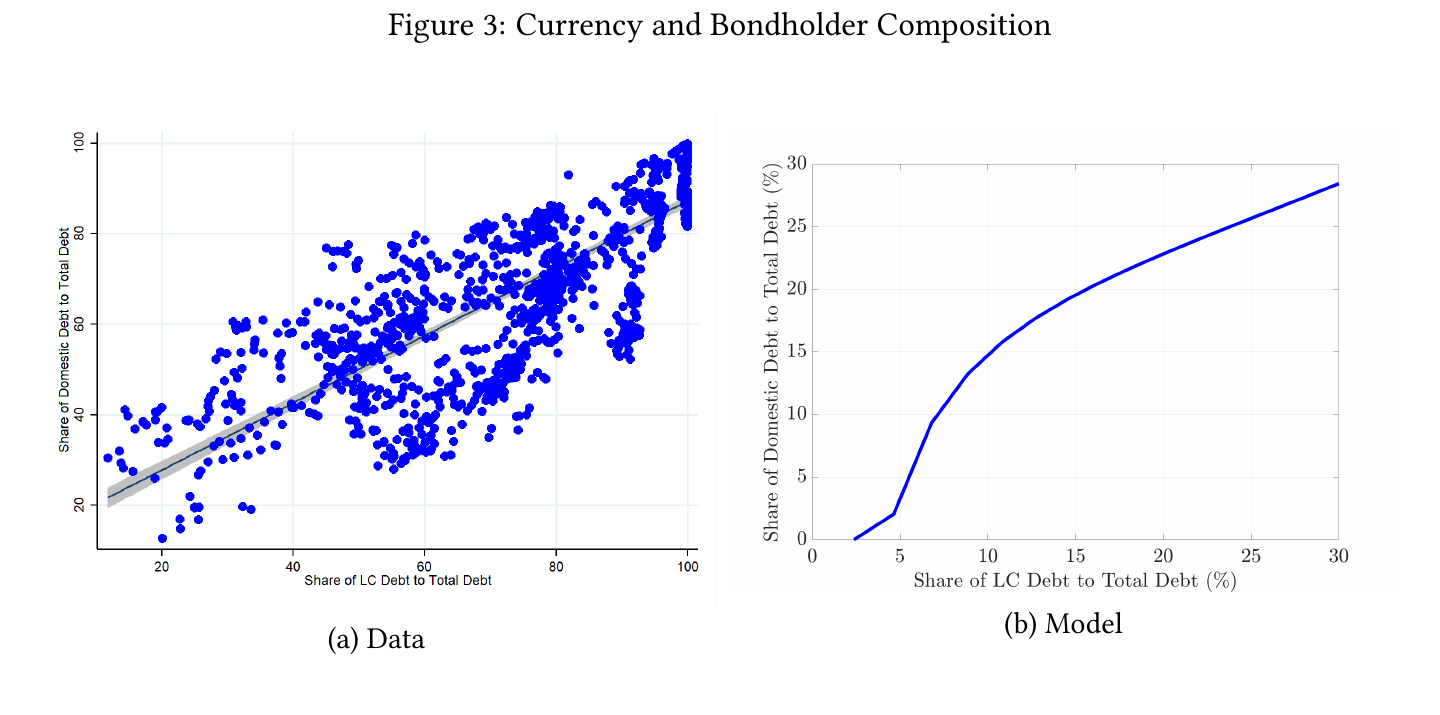
In emerging economies, local-currency bonds dominate government debt and are predominantly held by domestic investors. We develop a model that explains both facts jointly. Domestic investors prefer local-currency bonds because they provide insurance against distortionary taxation. The government exploits this preference: issuing local-currency debt stimulates domestic demand, which lowers default risk. As a result, issuing local-currency debt remains optimal even when it provides no fiscal insurance. Finally, we present empirical evidence from 17 emerging economies consistent with the model predictions.

Domestic Debt and Self-Fulfilling Crises

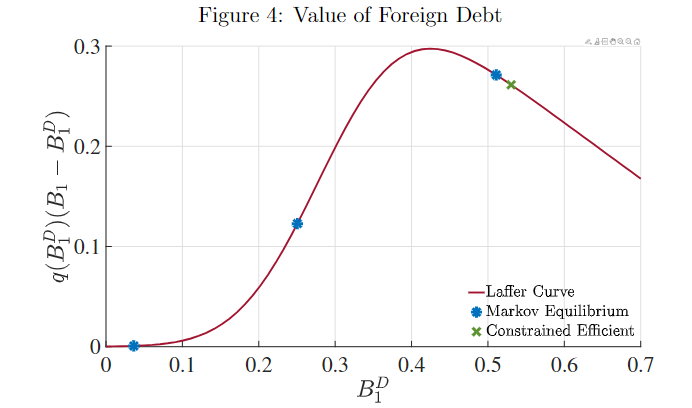
This paper shows the vulnerability of the government to face a self-fulfilling crisis characterized by low domestic demand for government bonds associated with a high probability of default. Investor expectations of low domestic demand increase foreign debt and default probability. High default risk decreases bond prices and prompts higher taxes or reduced government transfers. Consequently, domestic demand is low, confirming the initial expectation. I introduce a version of a sovereign debt model with domestic and foreign investors, analyze conditions for multiple equilibria, and establish that the government must announce a sequence of subsidies contingent on aggregate demand to restore efficiency.

Natural Disasters, Adaptation, and Default Risk

Co-Authors: Federico Dueñas - Oscar M. Valencia

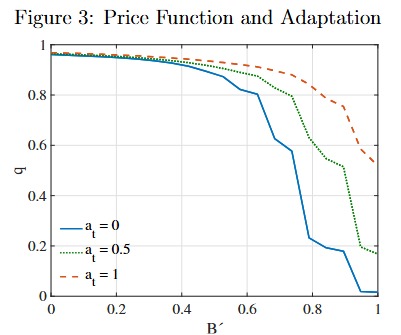
This paper studies the link between sovereign default risk and public investment in climate adaptation, which reduces the economic cost of natural disasters. We develop a sovereign default model that incorporates adaptation investment and quantify its effects on bond prices and fiscal policy. Our empirical analysis shows that countries with higher adaptation levels, measured by the ND-GAIN index, experience lower economic losses from disasters and reduced sovereign risk. We demonstrate that adaptation public investment is inefficiently low due to lack of commitment. Finally, we analyze how sovereign risk influences adaptation policy.

Sovereign Debt Crises and Monetary Policy

Co-authors: Javier Bianchi

We examine self-fulfilling debt crises in a model of a monetary union with nominal rigidities. In the absence of policy commitment, the model features multiple equilibria — one with low interest rates and another with high rates, echoing Calvo (1998). We show that a credible commitment to an expansionary monetary policy can eliminate the high-rate equilibrium and avert self-fulfilling crises. Finally, the risk of confidence crises can lead to endogenous fragmentation within the union, as interest-rate spreads diverge between countries. This asymmetry creates a trade-off for monetary policy, which must balance the differing conditions faced by high- and low-spread member states.